


A low taper fade with textured fringe is one of the most requested men’s haircuts of 2026, and for good reason. It keeps the sides neat with a gentle blend near the ears and neckline, while the top stays long enough to move, flop forward, and catch light in a natural, undone way.
This guide breaks down exactly what the cut is, why it works on nearly any face shape and hair type, and how to describe it to your barber so you leave the chair with the version you actually pictured. You’ll also find styling steps for home upkeep, a maintenance schedule, and answers to the questions men ask most before booking the appointment.
What Is a Low Taper Fade Textured Fringe?

A low taper fade textured fringe combines two distinct techniques into one cohesive haircut.
The taper fade portion controls the sides and back. Instead of dropping length in one abrupt line, a barber gradually reduces hair length as it moves down toward the ears and the nape of the neck. In a low taper, this blending starts close to the hairline, roughly at or just above the ear, so the transition is subtle and skin rarely shows through. This is different from a mid or high fade, which starts the blend much higher on the head and creates a bolder, more visible contrast.
The textured fringe is the front section of hair, styled forward over the brow instead of combed back or to the side. “Textured” means the fringe isn’t cut in one flat, blunt line. A barber uses point cutting, slide cutting, or thinning shears to break up the ends, so individual sections of hair separate and move independently rather than sitting as one solid block.
Put together, the result is a haircut that reads as clean and structured on the sides, but relaxed and full of movement up top. Because the fade stays low, more length is preserved around the sides and crown, which gives the fringe extra hair to work with when it’s styled forward.
Read More: Jack Hibbs: Age, Wife, Career & Net Worth Revealed 2026
Why This Style Became So Popular
Several practical reasons explain why this cut has held steady popularity through 2026 rather than fading as a short-lived trend.
- It suits almost any face shape. The low blend keeps the sides balanced without cutting too aggressively into the temple area, so it rarely fights against natural proportions.
- It works across hair types. Straight, wavy, curly, and coily hair can all be shaped into a textured fringe, since the technique relies on cutting method rather than a specific texture.
- It grows out cleanly. Because the fade starts low, the regrowth period looks presentable for longer compared with high or skin fades that show a visible line within a couple of weeks.
- It’s low maintenance relative to its payoff. A few minutes of styling most mornings is enough to keep the fringe looking intentional.
- It photographs well. The textured finish avoids the flat, helmet-like look of a blunt cut, which matters for a generation that documents haircuts on social platforms.
This combination of practicality and style is also why barbers frequently recommend it to first-time clients who want a change without committing to something extreme.
Variations of the Low Taper Fade with Textured Fringe
The base structure stays the same across variations. What changes is the length, texture, and finish of the fringe itself.
Short Textured Fringe

This version keeps the fringe close to the brow, usually one to two inches long, choppy at the ends. It suits guys who want the look without daily styling, since shorter hair naturally falls into place with minimal product.
Wavy Fringe with Low Taper

Natural or styled waves add dimension to the fringe without extra effort. A light sea salt spray or texturizing cream helps define the wave pattern while keeping the finish matte rather than wet-looking.
Curly Fringe Low Taper

Curly hair adds built-in texture, so the fringe often needs less cutting work to look layered. Barbers typically leave extra length on top for this variation, since curls shrink upward as they dry and set.
Messy Textured Fringe

This is the most relaxed take on the cut. Hair is pushed forward and left slightly disheveled rather than combed into a defined shape. It reads as effortless, though it usually relies on a light styling product to hold the “undone” finish in place.
Layered Fringe with Low Taper

Layering adds visible depth by cutting sections of the fringe to different lengths. This works especially well on thick or dense hair, since it removes bulk and creates movement that a single-length fringe can’t achieve.
Read More: Raven Tracy Age 2026: How Old Is She Really?
| Variation | Best For | Styling Effort |
| Short Textured Fringe | Fine or thin hair | Low |
| Wavy Fringe | Naturally wavy or straight hair with product | Medium |
| Curly Fringe | Curly or coily hair | Low to medium |
| Messy Textured Fringe | Thick, straight, or wavy hair | Medium |
| Layered Fringe | Dense or thick hair | Medium |
How Your Barber Creates This Haircut

A skilled barber follows a fairly consistent process for this cut, though small adjustments happen based on hair density, growth pattern, and cowlicks.
- The barber checks hair density, growth direction, and any cowlicks before starting, since these affect how the fade and fringe will lie once finished.
- Clippers with descending guard sizes create the low taper, starting near the ear and neckline and blending upward.
- Blending shears or a clipper-over-comb technique soften the line between the faded sides and the longer top, removing any harsh transition.
- The top section is sectioned off and cut to the desired fringe length, usually two to three inches for a textured look.
- Point cutting or slide cutting is used on the fringe to break up blunt ends and build texture.
- The hairline and neckline are cleaned up with a straight razor or trimmer for a crisp finish.
What to Say to Your Barber
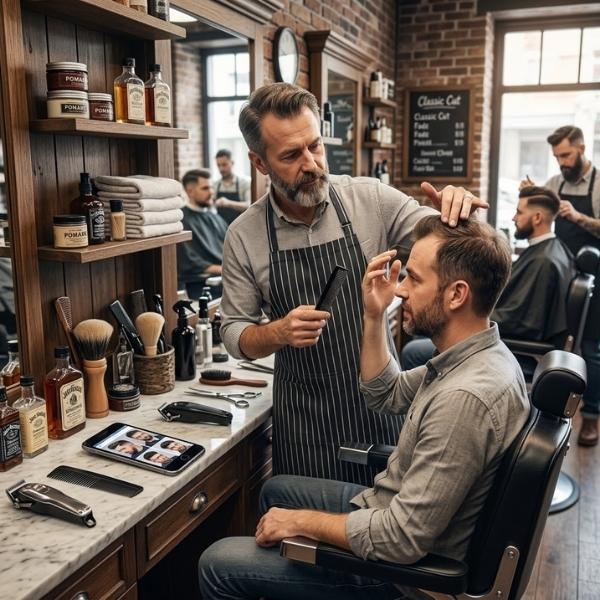
Clear communication matters more than memorizing technical terms. A simple, direct request works best:
“Please keep the taper low around my sideburns and neckline rather than rising toward my temples. I’d like a textured fringe on top, around two to three inches long, styled forward with a natural, not-too-polished finish.”
Bringing a reference photo helps close any gap between the words you use and the image in your head, since terms like “messy” or “textured” can mean slightly different things to different barbers.
How to Style a Low Taper Fade Textured Fringe at Home
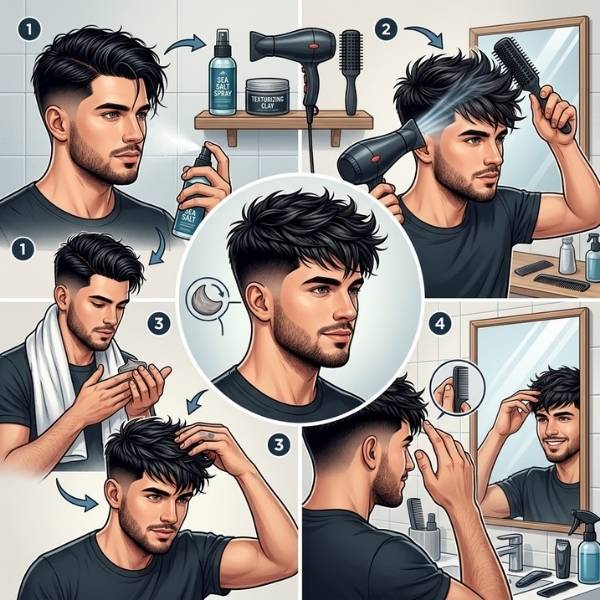
Styling this cut at home takes only a few minutes once you know the steps.
- Start with clean, towel-dried hair rather than fully dry hair, since damp hair holds shape better.
- Apply a small amount of lightweight pre-styler, sea salt spray, or heat protectant, distributing it evenly through the fringe.
- Push or comb the fringe forward with your fingers while the hair is still damp.
- For straight or wavy hair, use a round brush and a blow-dryer on a low or medium setting to add lift at the root.
- For curly hair, use a diffuser attachment on low heat to encourage natural curl definition instead of stretching it out.
- Once the hair is dry, work in a small amount of texture powder, matte clay, or a light pomade to define separation.
- Start with a smaller amount of product than feels necessary. Too much weighs the fringe down and removes the natural movement that defines the cut.
Maintenance and Hair Care

Keeping this haircut sharp requires attention both in the barber’s chair and at home between visits.
Barber Visits
Most men need a trim every three to five weeks to keep the fade crisp and the fringe from growing past its intended shape. Faster-growing hair may need visits closer to the three-week mark, while slower-growing hair can often stretch to five or six weeks before the fade starts to look uneven. If the fringe begins falling into your eyes or losing its defined edges, that’s usually a sign it’s time to book an appointment rather than waiting for a fixed date.
Read More: Short Wolf Cut Men 2026: Best Styles for Every Hair Type
At-Home Care
A few simple habits extend the life of the cut between visits.
- Use a sulfate-free shampoo to avoid stripping natural oils, especially if you use styling products daily.
- Apply a lightweight conditioner focused on the top section, since the fringe takes the most daily styling stress.
- Avoid washing hair every single day if it tends toward dryness, since natural oils help the fringe hold texture.
- Use a wide-tooth comb or your fingers rather than a fine-tooth comb when detangling, to avoid disrupting the layered texture.
- Trim split ends yourself only if you’re confident with scissors; otherwise leave fringe upkeep to your barber to protect the shape.
Who This Haircut Suits Best
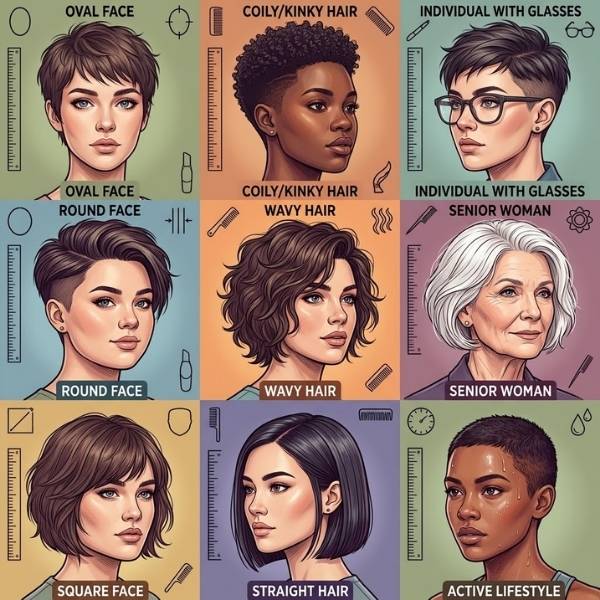
While this cut adapts to most people, certain face shapes and hair types get more out of it than others.
Face Shapes
- Oval faces are considered the most balanced shape, and this cut maintains that balance since the sides stay proportional while the fringe adds interest up front.
- Round faces benefit from the tighter, low-blended sides, which visually elongate the face, while a fringe with some forward projection adds length.
- Square faces pair well with a softer, textured fringe, since the movement on top offsets the strong jawline and squared angles.
- Heart-shaped faces work best with a fuller fringe that’s styled slightly to the side rather than dead center, which balances a wider forehead against a narrower chin.
Hair Types

- Straight hair takes well to a blow-dried, root-lifted finish and works especially well with the wavy or messy fringe variations when paired with a texturizing product.
- Wavy hair naturally complements the textured cutting technique, since the cut simply enhances a pattern that’s already there.
- Curly hair needs extra length left on top during the cut, since curls shrink as they dry, and benefits most from diffusing rather than straight blow-drying.
- Thick or dense hair suits the layered fringe variation best, since layering removes bulk without sacrificing overall volume.
- Fine or thin hair usually looks best with a shorter textured fringe, since less length means less risk of the hair falling flat by midday.
The Style’s Journey and What’s Ahead
The taper fade itself traces back to barbershop traditions that favored gradual, blended transitions over sharp lines, and it has remained a staple men’s cut for decades because of how well it adapts to changing trends on top. What changed more recently is the pairing with a deliberately textured fringe rather than a slicked-back or side-parted finish. As styling products became more accessible and barbering technique became more visible through social platforms, more men began requesting the relaxed, forward-styled fringe paired with the cleaner low fade.
Heading further into 2026, the style shows no signs of slowing down. Its appeal rests on genuine versatility rather than a passing aesthetic. It can be dressed up for a formal setting with a slightly more polished fringe, or worn loose and undone for a casual day. Because it works across nearly every hair type and face shape, barbers expect it to remain a default recommendation for clients who want a modern cut that still reads as professional.
Low Taper Fade Textured Fringe: Asked Questions
Men researching this haircut most often want to know how it compares to similar styles and whether it fits their specific hair. In short, it differs from a French crop mainly in fringe length and fade height. It differs from a classic undercut mainly in how gradual the blend is
. And it suits nearly every hair type because the texturizing technique, not the natural hair pattern, does most of the work in creating movement. If you’re unsure whether your hair or face shape is a good fit, a consultation with your barber before the first cut is the safest way to confirm it.
Conclusion
A low taper fade with textured fringe earns its popularity by solving a common problem: how to look sharp and put-together without sacrificing natural movement or spending a long time styling each morning. The low blend keeps the sides clean and lets the cut grow out gracefully, while the textured fringe adds personality that a flat, uniform cut simply can’t match.
Whether you choose a short, wavy, curly, messy, or layered fringe, the underlying structure gives you a haircut that adapts to your face shape, your hair type, and your daily routine. Bring a clear description or reference photo to your next barber visit, and this cut can become your long-term go-to rather than a one-time experiment.
FAQs
How often should I visit my barber for this cut?
Plan on a trim every three to five weeks to keep the fade crisp and the fringe from losing its shape.
Does a textured fringe work on straight hair?
Yes. Straight hair takes well to blow-drying and texturizing products, which build the movement the cut relies on.
What is the easiest way to style this at home?
Apply product to damp hair, push the fringe forward with your fingers, and blow-dry with a round brush for lift.
Is the low taper fade good for growing out?
Yes. Since the blend starts low, regrowth looks presentable for longer compared with mid or high fades.
Can I add color or highlights to this cut?
Yes. Subtle highlights or a full color change both work well, since the fringe’s texture helps show off color dimension.
What is the difference between a textured fringe and a blunt fringe?
A textured fringe has broken, layered ends for movement, while a blunt fringe is cut in one straight, solid line.
Is this cut high maintenance?
It’s moderate. Daily styling takes a few minutes, and regular barber visits every three to five weeks keep it sharp.
Does this haircut work for men with beards?
Yes. The low taper pairs well with most beard styles, from light stubble to a fuller, groomed beard.

Zaria Rhodes is the lead editor and content curator at Lyrinexa, passionate about music, storytelling, and lyrical expression. With a deep love for discovering the meaning behind songs, she brings clarity, creativity, and accuracy to every post. Zaria is dedicated to providing readers with authentic lyrics, thoughtful interpretations, and a seamless music-exploration experience.
