


The short wolf cut men trend has become one of the most requested barbershop looks of 2026, and for good reason. It takes the volume and rebellious energy of the classic wolf cut and compresses it into a shape that is easier to grow out, easier to style, and easier to keep looking sharp between visits. Instead of relying on long layers down the neck, the short version builds its personality through crown lift, textured ends, and a tighter perimeter.
It works across nearly every hair type, from pin straight to tightly curled, though each texture needs a slightly different approach at the chair. This guide walks through the exact adjustments barbers make for each hair type, plus the styling habits that keep the cut looking intentional long after the first wash.
What Is a Short Wolf Cut Men Haircut
A short wolf cut sits in the middle ground between a shag haircut and a mullet, borrowing the layered crown from one and the slightly longer nape from the other, then trimming both down to a shorter overall length. Unlike a full-length wolf cut, which can reach the collar or beyond, the short version keeps most of the length at ear level or above, with only a small amount of extra length left at the back for shape.
Three features separate a true wolf cut from a plain layered haircut:
- Volume at the crown. The layers here are cut shorter and choppier than the rest of the head, which lifts the hair upward instead of letting it lie flat.
- A tapered or slim perimeter. The sides and neckline stay close to the head so the volume up top reads as intentional rather than overgrown.
- A slightly extended nape. Even a few extra millimeters of length at the back of the neck gives the cut its signature silhouette.
Barbers sometimes describe it as a “compact shag” or a “cropped mullet hybrid,” and either description gets the point across at the chair. The result is a haircut that looks textured and lived in without the maintenance that comes with longer hair.
Read More: Bayard Martensen: The Carver Twins’ Hidden Financial Genius
Short Wolf Cut Men Hairstyle Basics
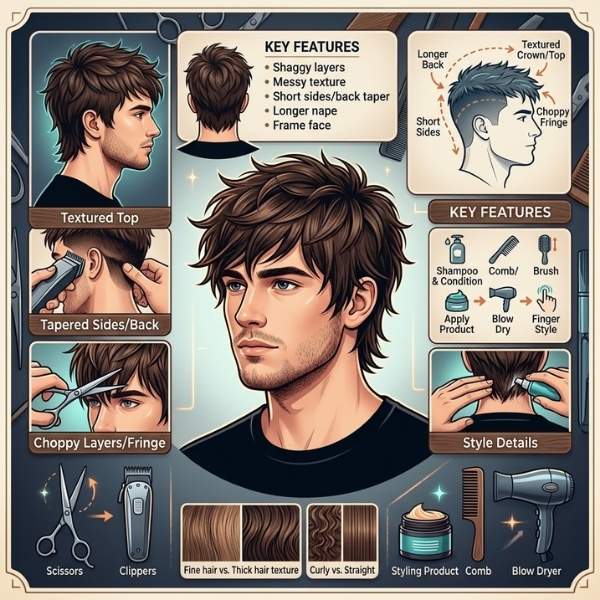
Every version of this cut is built on the same three-part foundation, regardless of hair type or personal style: crown layering, a defined front section, and a clean outline. Getting any one of these wrong changes the entire look.
- Crown layering creates the lift that gives the cut its shape. Layers that are too long sit flat; layers cut too short can look spiky instead of soft.
- The front section, sometimes called a fringe or face-framing piece, controls how the cut reads from the front. It can be swept to one side, pushed forward, or left loose depending on face shape and personal taste.
- A clean outline around the ears and along the neckline keeps a short cut from looking unfinished. Because there is less overall length, any stray hair around the edges stands out more than it would on a longer style.
Bring a reference photo that matches your own hair texture when you sit down with your barber. A photo of straight hair on a client with naturally curly hair, for example, will not translate the way you expect, since curl pattern changes how layers fall once they are cut. Describing the look in words alone rarely produces the same result as a clear visual reference paired with a conversation about your specific hair type.
Short Wolf Cut Men Straight Hair

Straight hair has no natural texture to lean on, so the cut has to create movement through technique rather than relying on the hair to do the work. The main risk with straight strands is a flat crown, since gravity pulls straight hair down almost immediately after styling.
To counter this, ask for these three barber techniques:
- Point cutting at the ends, which breaks up the blunt line and lets hair fall in separated pieces instead of one heavy sheet.
- Weight removal at the crown, so the top section is light enough to hold lift without a mountain of product.
- A soft, textured fringe rather than a straight-across bang, which softens the overall silhouette.
Thick straight hair benefits from a bit of internal thinning near the temples to prevent the sides from puffing outward, while fine straight hair usually looks better with minimal thinning, since removing too much weight can make it look thin and wispy. A dab of styling cream worked into damp roots, followed by a short blast of low heat while lifting with your fingers, is usually enough to keep a straight short wolf cut standing up through the day.
Short Wolf Cut Men Wavy Hair

Wavy hair is often considered the easiest texture for this style, since the natural bend already supplies the movement and volume that straight hair has to fake. The challenge with waves is not flatness, it is bulk. Waves tend to expand outward at the sides and behind the ears, which can make the head look wider than intended if the cut is not shaped carefully.
A barber working with wavy hair will typically:
- Remove weight around the temples and behind the ears to keep the silhouette narrow.
- Leave the crown layered so waves lift up rather than spread sideways.
- Cut a soft, slightly longer fringe that follows the natural wave pattern instead of fighting it.
For daily upkeep, a lightweight sea salt spray or curl cream scrunched into damp hair usually beats a heavy pomade, since wavy hair styles best when it is allowed to dry with minimal disturbance. Touching wavy hair too much while it dries tends to break up the natural pattern and create frizz instead of definition.
Short Wolf Cut Men Curly and Curly Hair Short Wolf Cuts Men

Curly hair follows a different rulebook entirely because of shrinkage. A layer that looks medium length while the hair is wet can shrink up by an inch or more once it dries and the curl pattern springs back. Barbers who are not used to cutting curly hair sometimes trim layers too short as a result, which flattens the wolf shape and leaves an uneven silhouette once the hair dries.
Key things to ask for with curly hair:
- Layers cut with the curl pattern in mind, allowing for shrinkage rather than cutting to a fixed wet length.
- A taper or gentle fade on the sides rather than a hard shave, since a stark contrast can look harsh against dense curls.
- A precise neckline, since short curly styles expose more of the neck than longer curly cuts do.
Curl-specific cutting methods, sometimes called dry cutting or curl-by-curl cutting, are worth seeking out if your barber offers them. These approaches shape each curl in its natural, dried state rather than cutting the hair wet and hoping for the best, which tends to produce a much more accurate result on tightly coiled or springy curl types.
Read More: Danny Go Net Worth 2026: Inside His Rise to Riches
Messy Short Wolf Cut Men

The messy version of this cut relies on an illusion. It has to look effortless while actually depending on a very deliberate haircut underneath. Piecey, separated layers at the crown create the tousled effect, but the neckline and sideburns stay crisp and clean, which is the detail that keeps the whole look from reading as simply unkempt.
To style it at home:
- Work with damp, not soaking wet, hair.
- Apply a small amount of matte paste or clay to your fingertips, not directly to the hair.
- Push your fingers through the crown in different directions to break up uniformity.
- Nudge the fringe slightly off center rather than combing it flat.
- Let it air dry or use a diffuser on low heat to lock the texture in place.
Skip the comb for this style entirely. A comb smooths hair into uniform lines, which is the opposite of the piecey, separated finish the messy wolf cut depends on.
Short Wolf Cut Men Asian

Asian hair textures are commonly thick, straight, and dense, which gives the wolf cut a strong, structured base to work from. The tradeoff is bulk. Without weight removal, thick straight hair tends to sit heavy through the sides and back, which can flatten the layered effect the cut is supposed to show off.
Barbers usually address this with:
- Internal debulking, thinning hair from underneath the top layer rather than cutting the surface shorter, which keeps length while reducing weight.
- Feathered ends at the crown and fringe to break up the density.
- A precise outline around the ears, since dense hair has a tendency to flare outward if the perimeter is not shaped tightly.
A soft side part or a gently swept fringe tends to look more modern on this hair type than a heavy, blunt bang. Once the internal weight is properly removed, thick straight hair actually holds a wolf cut shape longer between visits than finer textures do, since there is more hair to maintain the crown lift as it grows.
Short Wolf Cuts Men Korean and Korean Short Wolf Cut Men
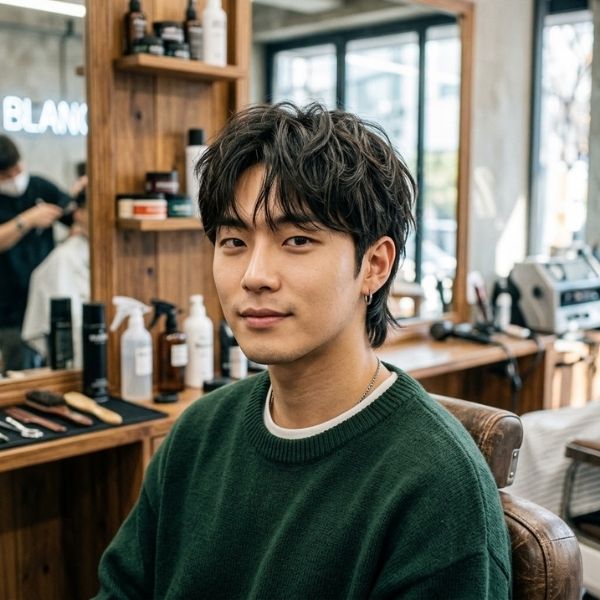
The Korean take on this style trades edge for polish. Where other versions of the wolf cut lean into rough texture and contrast, the Korean short wolf cut favors a lighter, airier finish that works equally well in casual and professional settings. It has become closely associated with K-pop styling and Korean street fashion, both of which favor soft layering over choppy, aggressive texture.
Distinctive features of this variation include:
- A light, wispy fringe rather than a thick, heavy bang.
- Soft, blended crown layers instead of choppy, piecey ones.
- Face-framing pieces that sit close to the cheekbones without standing out dramatically.
- A clean, precise outline around the ears and neckline.
To recreate the look, ask your barber for soft layering rather than heavy texturizing, and request a fringe that grazes the brow rather than sitting well above it. At home, a lightweight styling cream or light-hold spray keeps the finish soft, since anything with strong hold or high shine works against the relaxed, quietly polished look this variation is known for.
Read More: Raven Tracy Age 2026: How Old Is She Really?
Quick Styling Routine
| Step | What To Do | Why It Matters |
| 1 | Start with hair around 70 percent dry | Damp hair holds product and shape better than fully dry or soaking wet hair |
| 2 | Lift the crown with your fingers | Builds the volume that defines the wolf silhouette |
| 3 | Apply a small amount of matte clay or texture spray | Adds hold without weighing the layers down |
| 4 | Direct the fringe with your hands, not a comb | Keeps the piecey, natural finish intact |
| 5 | Finish with a low-heat blast for straight or wavy hair, or air dry for curls | Locks the shape in without overheating the hair |
Common Mistakes and Easy Fixes
A handful of issues come up again and again with this haircut, and most of them are simple to correct with a small change at the barber chair or in your daily routine.
- Bulky sides that widen the head. This usually means the sides need internal weight removal, not just a shorter clipper guard. Ask specifically for thinning rather than length reduction.
- A flat crown. Often caused by layers that are too long or a skipped blow dry step. A few seconds of root lift with a blow dryer, or slightly shorter crown layers, usually solves it.
- Curly layers cut too short. Remind your barber about shrinkage before the first cut. Curly hair should be cut longer than the desired dry length to account for how much it will spring up.
- A rough or uneven neckline. Short cuts expose more of the neck, so any unevenness is more noticeable than it would be on longer hair. A clean, straight-edge finish at the neckline solves this quickly.
- Over-styling with heavy product. Thick pomades and gels fight against the loose, textured look the wolf cut is built around. Switch to a lighter matte product used sparingly.
Quick Answers Guys Ask
Most questions about this style come down to hair type and upkeep. Straight hair needs texture engineered into the cut through point cutting and feathering, since it has none on its own. Wavy hair needs side control so the natural bend does not add unwanted width. Curly hair needs longer layers to account for shrinkage and a precise neckline since curls expose more skin at short lengths.
On maintenance, a well-cut short wolf cut typically holds its shape for four to six weeks before it starts looking overgrown, with the crown layers usually softening first. Product needs are minimal across all hair types. A small amount of a light, matte finishing product is enough for most guys, and reaching for more product rarely improves the look, it usually just weighs the layers down and kills the natural movement that makes the cut work in the first place.
FAQs
Is the Short Wolf Cut Men Style Hard to Maintain Daily
No. Finger styling on slightly damp hair takes about two minutes once the cut has grown in properly, making it one of the lower maintenance options among trendy men’s haircuts.
Does the Short Wolf Cut Men Work for Thick Hair
Yes. Thick hair actually holds the shape well once internal debulking removes excess weight from the sides, keeping the silhouette slim instead of puffy.
Can Short Wolf Cut Men Style Suit All Face Shapes
Most face shapes carry this cut with small adjustments. Rounder faces benefit from extra crown height, while square or angular faces often look best with softer, lighter layers framing the edges.
What Is the Best Product for Short Wolf Cut Men Styling
A light matte clay, texturizing spray, or curl cream depending on hair type works better than heavy gels or high-shine pomades, which flatten the texture this cut relies on.
How Often Should You Trim a Short Wolf Cut Men Hairstyle
Every four to six weeks keeps the layers fresh and the neckline sharp. Waiting much longer lets the crown lift soften and the overall shape start to blur.
Conclusion
The short wolf cut men trend earns its popularity by offering the texture and personality of a longer wolf cut without the growing-out phase that comes with it. Straight hair needs engineered texture, wavy hair needs side control, curly hair needs longer layers for shrinkage, and thick or Asian hair textures benefit most from internal debulking.
Whichever version fits your hair, the underlying formula stays the same: layered crown for lift, a defined front section, and a clean, tight outline around the ears and neck. Bring a clear reference photo, communicate your hair type honestly, and book a trim every four to six weeks, and this cut will keep looking sharp well past the first week out of the chair.

Zaria Rhodes is the lead editor and content curator at Lyrinexa, passionate about music, storytelling, and lyrical expression. With a deep love for discovering the meaning behind songs, she brings clarity, creativity, and accuracy to every post. Zaria is dedicated to providing readers with authentic lyrics, thoughtful interpretations, and a seamless music-exploration experience.

1 thought on “Short Wolf Cut Men 2026: Best Styles for Every Hair Type”