


Scroll through any barbershop’s Instagram page right now and you’ll likely spot the same haircut on repeat: tight, clean sides that fade low near the ears, topped with a choppy, movement filled fringe falling over the forehead. That’s the low taper fade with textured fringe, and it has quietly become one of the most requested men’s haircuts of 2026.
Part of its appeal is how adaptable it is. Straight, wavy, curly, thick, or fine, this cut bends to fit almost any hair type and face shape without losing its identity. It also works across settings, sharp enough for the office, relaxed enough for the weekend.
This guide breaks down exactly what the haircut is, why barbers and clients keep coming back to it, the most popular variations, how to ask for it correctly, how to style it at home, and how to keep it looking fresh between visits.
What Is a Low Taper Fade Textured Fringe?

A low taper fade with textured fringe combines two separate barbering techniques into one cohesive style.
The low taper fade handles the sides and back. Instead of fading high up near the crown, the taper begins closer to the ears and neckline. Hair shortens gradually rather than dropping sharply from long to skin, which creates a softer, more natural transition than a mid or high fade.
The textured fringe covers the top and front section. Rather than cutting the fringe into one blunt, solid line, a barber uses point cutting, slide cutting, or razor work to break up the ends. This adds separation and depth, so the front section falls forward with a piecey, lived-in texture instead of looking flat or heavy.
Put together, you get a haircut that reads as clean and controlled on the sides while staying expressive and full of movement on top. The contrast between the two sections is really what makes the style work. The precision of the fade anchors the look, while the choppy fringe keeps it from feeling stiff or overly formal.
Read more: Burst Fade Design: Best Hair Design Ideas, Placement, and Barber Tips (2026)
Why This Style Became So Popular
A few reasons explain why this haircut keeps showing up in every men’s hairstyle search this year.
- It suits nearly everyone. Because the taper stays low, it doesn’t expose much scalp, which makes it a gentler, less dramatic option than a high skin fade. Paired with a fringe that softly frames the face, it flatters a wide range of face shapes and hair densities.
- It works with natural texture. Barbers don’t need to fight your hair type to make this cut look good. Straight, wavy, and curly hair all take the texturing techniques differently, which means the same base haircut can look completely different from client to client.
- It transitions between settings. Style the fringe neatly forward for the office, then tousle it with a little more product for the weekend. One cut, several looks, without a trip back to the chair.
- It’s low commitment. Because the taper is subtle rather than dramatic, growth between appointments is far more forgiving than it is with a skin fade.
- Social media keeps it visible. Barbers post finished results constantly, and the texture on top photographs well, which keeps the style circulating and requested.
Variations of the Low Taper Fade with Textured Fringe
One of the biggest strengths of this haircut is how many ways it can be worn. Below are the variations clients ask for most.
Short Textured Fringe
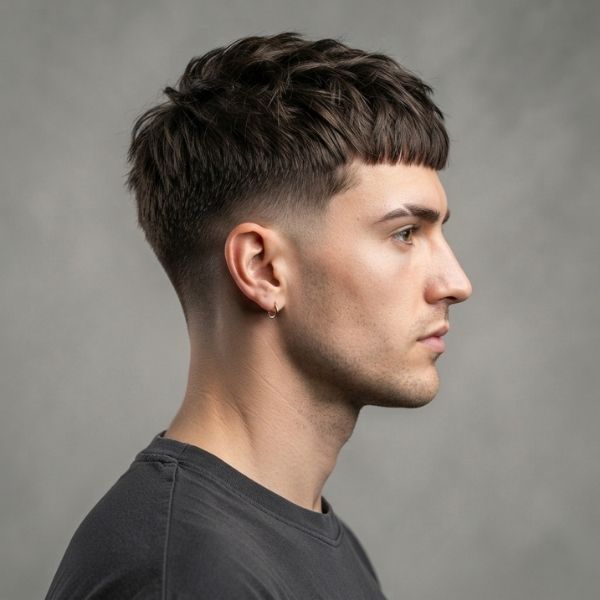
This version keeps the fringe close to the brow, usually around 1.5 to 2 inches on top. It’s the lowest maintenance option in the group, ideal for guys who want the texture without a lengthy morning routine. A small amount of matte paste worked through damp hair is typically all it needs.
Read more: Mid Fade Crew Cut Hairstyle: Sharp, Simple, Modern
Wavy Fringe with Low Taper

Natural waves add movement on their own, so the barber leaves slightly more length in the fringe to let that wave pattern show through. The low taper keeps the sides from competing with the texture on top, and a light sea salt spray helps define the natural bend without weighing it down.
Curly Fringe Low Taper

Curls shrink as they dry, so barbers usually cut this version a little longer than it will end up looking once it settles. A curl defining cream applied to soaking wet hair, followed by air drying, keeps the curl pattern crisp instead of frizzy. The low taper on the sides balances the extra volume up top.
Messy Textured Fringe
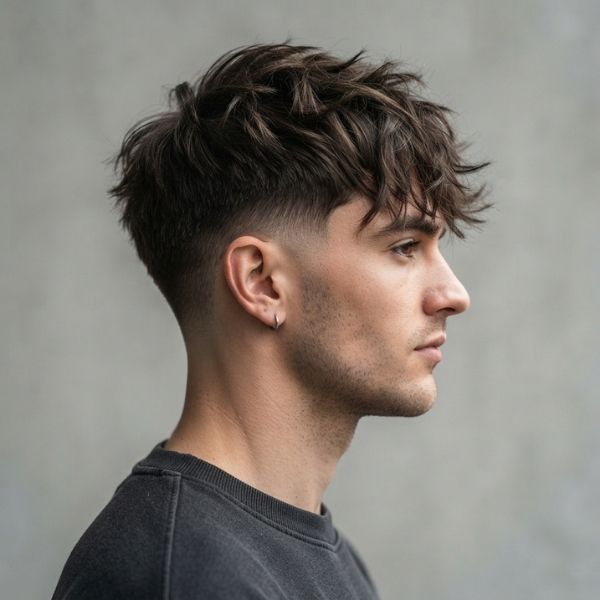
This is the most tousled, undone take on the cut. Instead of styling the fringe into a set direction, it’s scrunched or finger styled for a deliberately imperfect look. A matte clay with a strong hold is key here since it needs to hold texture without adding shine or a slicked appearance.
Layered Fringe with Low Taper

Here, the barber cuts the top in visible layers rather than one uniform length, which adds dimension and makes fine or thin hair appear fuller. It’s a strong pick for guys who want more visual detail without going as extreme as a fully choppy fringe.
How Your Barber Creates This Haircut
Understanding the process helps you know what to expect in the chair and gives you the vocabulary to communicate clearly.
- Consultation. A good barber starts by checking your hair type, growth pattern, cowlicks, and face shape before touching the clippers.
- The taper. Clippers move from the neckline and around the ears upward, blending gradually rather than jumping between guard lengths. Since it’s a low taper, most of the blending stays below the temple.
- Blending the sides into the top. The barber connects the tapered sides smoothly into the longer top section so there’s no visible line of demarcation.
- Texturizing the fringe. Using scissors, a razor, or thinning shears, the barber removes bulk and adds separation to the front section. Point cutting creates soft, jagged ends, while slide cutting removes weight while keeping length.
- Final shape and check. The fringe is combed forward and checked in the mirror from multiple angles to make sure the length and shape suit your forehead and hairline.
What to Say to Your Barber
Bring a reference photo whenever possible since barbers interpret “low taper” and “textured” differently. Beyond the photo, these details help:
- Ask specifically for a low taper fade, and mention that you want it to start near the ears, not higher up.
- Request a textured fringe using point cutting or a razor, rather than a blunt, one-length fringe.
- Tell them your preferred fringe length in inches if you know it (short, around 1.5 to 2 inches, or longer for more styling flexibility).
- Mention your hair type. Curly or wavy hair often needs extra length left in to account for shrinkage or natural movement.
- If you have a cowlick or a stubborn growth pattern, point it out before the cut starts.
How to Style a Low Taper Fade Textured Fringe at Home

You don’t need a long routine to keep this cut looking sharp day to day. Here’s a simple approach that works for most hair types:
- Start with damp, towel dried hair, not soaking wet.
- Apply a small, dime sized amount of matte clay, texture paste, or a light pomade, depending on your hold preference.
- Rough dry the fringe forward and slightly upward using your fingers or a diffuser, focusing airflow at the roots for lift.
- Once mostly dry, use your fingertips to separate strands and push the fringe into its final direction, whether that’s straight forward, side swept, or messy.
- Finish with a light texturizing spray if you want extra grip or a matte, piecey finish.
Avoid overloading the fringe with product. A little goes further with texture based styles, and too much can flatten the movement the haircut is built around.
Read more: Madison Alworth Wikipedia: Bio, Age & Net Worth 2026
Maintenance and Hair Care

Barber Visits
Plan on a trim every three to four weeks. The taper on the sides grows out faster than the top does, so the haircut can start looking uneven before the fringe even needs cutting. Regular visits keep the fade blended and the fringe at a length that’s easy to manage.
At-Home Care
- Wash with a sulfate free shampoo two to three times a week to avoid stripping natural oils that help with texture.
- Use a lightweight conditioner focused on the ends of the fringe rather than the roots, which can weigh the top down.
- Deep condition or use a hair mask every one to two weeks if your hair type runs dry or curly.
- Choose matte finish products over glossy ones if you want the texture to stay visible rather than looking wet or slicked.
- Store products with a firm hold for messy or layered variations, and lighter formulas for short, simple fringes.
Who This Haircut Suits Best
Face Shapes
- Oval faces can wear almost any version of this cut without adjustment.
- Round faces benefit from added height at the front, so a layered or blowout style fringe helps elongate the face.
- Square faces pair well with a softer, wavy fringe that takes some edge off strong jawlines.
- Heart shaped faces tend to suit a side swept or shorter fringe that doesn’t add extra width near the forehead.
Hair Types
- Straight hair shows off texture cleanly and works especially well with short, choppy fringe styles.
- Wavy hair adds natural movement and pairs nicely with a slightly longer, more relaxed fringe.
- Curly hair brings built-in volume, though barbers usually cut it a touch longer to allow for shrinkage.
- Thick hair benefits from texturizing since it removes bulk while keeping usable volume on top.
- Fine hair looks fuller with a shorter fringe and light styling, since heavier products can flatten it.
The Style’s Journey and What’s Ahead
The roots of this haircut trace back to the classic short back and sides styles that dominated barbershops for decades. Over time, barbers began adding more detail and movement to the top section rather than keeping it uniformly short, and the fringe element gained lasting popularity from there.
What’s different now is the pairing with a low taper specifically, rather than a mid or high fade. This shift reflects a broader move toward softer, more natural looking fades that still read as sharp and intentional. Social media accelerated the trend by giving barbers a platform to showcase finished cuts in real time, which pushed variations like the messy fringe and curly fringe versions into wider circulation.
Going forward, expect this haircut to keep evolving through subtle texture changes rather than dramatic redesigns, since its core appeal, a clean base with a customizable top, is already close to universal.
Low Taper Fade Textured Fringe: Asked Questions

How long should my hair be for a textured fringe?
Most barbers recommend at least 2 to 3 inches on top so there’s enough length to texturize and style with movement.
Does this haircut work with a beard?
Yes, a low taper fade pairs easily with most beard styles since the fade stays subtle and doesn’t compete with facial hair.
Can I get this cut with thinning hair?
Yes, a shorter, lightly textured fringe can actually help thinning hair look fuller by adding visible separation.
How is a low taper different from a mid or high fade?
A low taper starts near the ears and neckline, while mid and high fades begin higher up the head, exposing more scalp.
Conclusion
The low taper fade with textured fringe has earned its spot as one of 2026’s most requested men’s haircuts because it genuinely delivers on every front: it suits most face shapes and hair types, it transitions easily from work to weekend, and it doesn’t demand a complicated styling routine. Whether you prefer it short and simple, wavy and relaxed, or messy and undone, the same clean, low fade foundation ties every version together.
Bring a reference photo to your next barber appointment, describe your preferred fringe length and texture, and keep up with trims every three to four weeks. That’s really all it takes to keep this cut looking sharp all year round.
FAQs
What is a low taper fade with textured fringe?
It’s a men’s haircut that combines a low, gradual fade on the sides with a choppy, textured fringe left longer on top.
How often do I need a trim?
Every three to four weeks keeps the fade clean and the fringe at a manageable length.
What products work best for styling?
Matte clay, texture paste, or a light pomade all work well, depending on how much hold and shine you want.
Is this haircut good for curly hair?
Yes, barbers typically cut the fringe slightly longer for curly hair to account for shrinkage once it dries.
Can women get this haircut too?
While it’s marketed as a men’s style, the same taper and fringe technique can be adapted for shorter women’s haircuts as well.

Zaria Rhodes is the lead editor and content curator at Lyrinexa, passionate about music, storytelling, and lyrical expression. With a deep love for discovering the meaning behind songs, she brings clarity, creativity, and accuracy to every post. Zaria is dedicated to providing readers with authentic lyrics, thoughtful interpretations, and a seamless music-exploration experience.

1 thought on “Low Taper Fade with Textured Fringe: Complete Guide for 2026”