


A straight hair mullet men can wear is one of the most precise versions of this iconic haircut. Straight strands make the shape, layers, fade, and length difference highly visible, which can be a major advantage when the haircut is done correctly.
The modern mullet is also very different from the exaggerated styles associated with the 1980s. Today’s versions can be subtle, textured, tapered, faded, messy, or highly structured.
The basic idea remains simple: keep the front and sides shorter while leaving noticeably more length at the back. The modern approach focuses on making that difference look intentional rather than outdated.
Straight hair is particularly useful for creating clean lines and visible layers. However, it can also expose poor cutting quickly. If the crown lacks texture or the back has too much weight, the haircut can become flat, bulky, or disconnected.
This guide covers the best straight hair mullet styles, suitable lengths, face shapes, fade options, barber instructions, styling techniques, maintenance, and common mistakes.
What Is a Straight Hair Mullet Men?
A straight hair mullet is a haircut where the sides and front are shorter than the back, creating a distinct front-to-back length difference.
The modern version usually adds layers and texture so the transition feels more natural.
A typical straight hair mullet can include:
- Short or medium-length sides
- Textured hair through the crown
- A shorter or medium fringe
- Layered length through the back
- A tapered, faded, or scissor-cut outline
- A controlled neckline
The back does not necessarily need to reach the shoulders. A short nape can still create a recognizable mullet silhouette.
The defining feature is the difference in length between the sides and back, not a specific measurement.
Why Does a Mullet Work So Well With Straight Hair?
Straight hair makes the architecture of a haircut easy to see.
Every layer creates a visible line. Every change in length affects the silhouette. Every fade is easier to notice.
That precision can make straight hair mullets look exceptionally sharp.
There is one downside: straight hair can also fall flat.
If the top is cut with insufficient texture, it may sit close to the scalp. If the back is left too heavy, it can hang rather than flow.
For that reason, a successful straight hair mullet usually needs careful weight distribution.
Modern barber guides emphasize that straight hair benefits from texture and thoughtful layering because excessive weight can make the back look heavy.
Best Straight Hair Mullet Styles for Men
There is no single way to wear this haircut. Your choice should depend on how bold you want the style to be and how much maintenance you are comfortable with.
1. Modern Straight Hair Mullet

The modern mullet is the safest starting point for most men.
It keeps some length at the back but avoids an exaggerated tail.
The top is usually textured, while the sides can be tapered or softly faded.
This creates a smoother connection between the crown and nape.
It is especially suitable if you want a recognizable mullet that still feels contemporary.
Best for: Medium or thick straight hair and men trying a mullet for the first time.
Ask your barber for: A layered modern mullet with textured crown, controlled sides, and a soft transition into the nape.
Read More: Messy French Crop Men: Best Styles, Hair Types, Barber Guide & Styling Tips
2. Low Taper Mullet

A low taper keeps the sides relatively full while cleaning the area around the temples, sideburns, and neckline.
It creates less contrast than a skin fade.
That makes it one of the most wearable choices for men who want a mullet without making the haircut extremely dramatic.
A low taper can also make the haircut easier to grow out because there is less aggressive fading to maintain.
Best for: Professional settings, first-time mullet wearers, and men who prefer a natural appearance.
3. Low Fade Mullet

A low fade creates more contrast than a taper while keeping the fade relatively close to the lower sides.
The textured top and longer back become more noticeable.
This is a strong choice if you want something modern but not overly aggressive.
The fade should remain low enough that it does not destroy the connection between the top, sides, and back.
4. Mid Fade Mullet

A mid fade creates a stronger visual separation.
It works particularly well if you want the haircut to have a more obvious contemporary barber-shop appearance.
Straight hair makes the fade line and transition easy to see, so precision matters.
This style usually requires more frequent cleanup than a softer taper.
5. Burst Fade Mullet
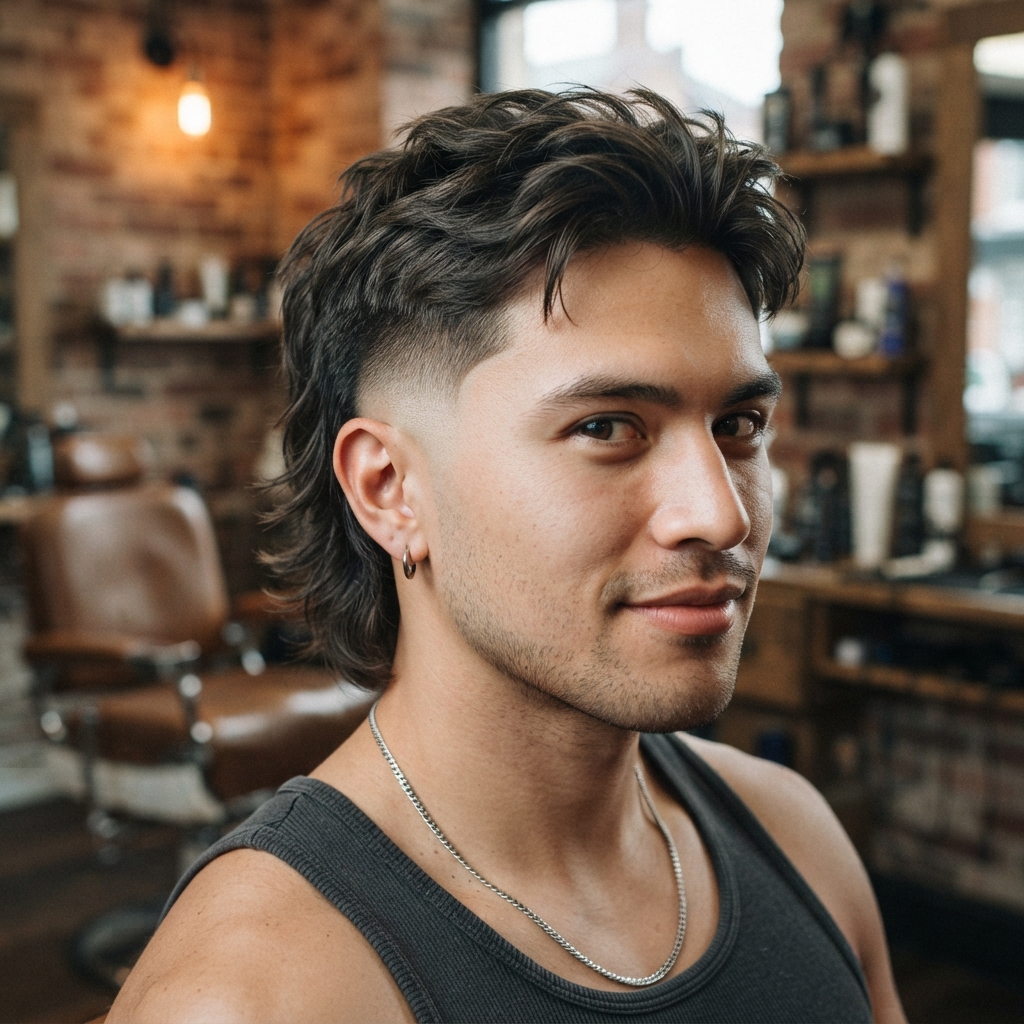
The burst fade curves around the ear rather than fading evenly across the entire side.
This leaves more hair behind the ear while creating a clean transition around the ear itself.
The result works particularly well with a longer, layered nape.
A low burst fade is the more conservative version, while a higher burst fade produces greater contrast.
6. Short Mullet

A short mullet is ideal if you want to experiment without committing to a long back.
The nape extends only modestly beyond the sides.
This creates a subtle mullet shape while keeping the haircut practical for school, work, sports, or everyday life.
It is also a good option if you are unsure whether a longer mullet will suit your face.
7. Textured Mullet
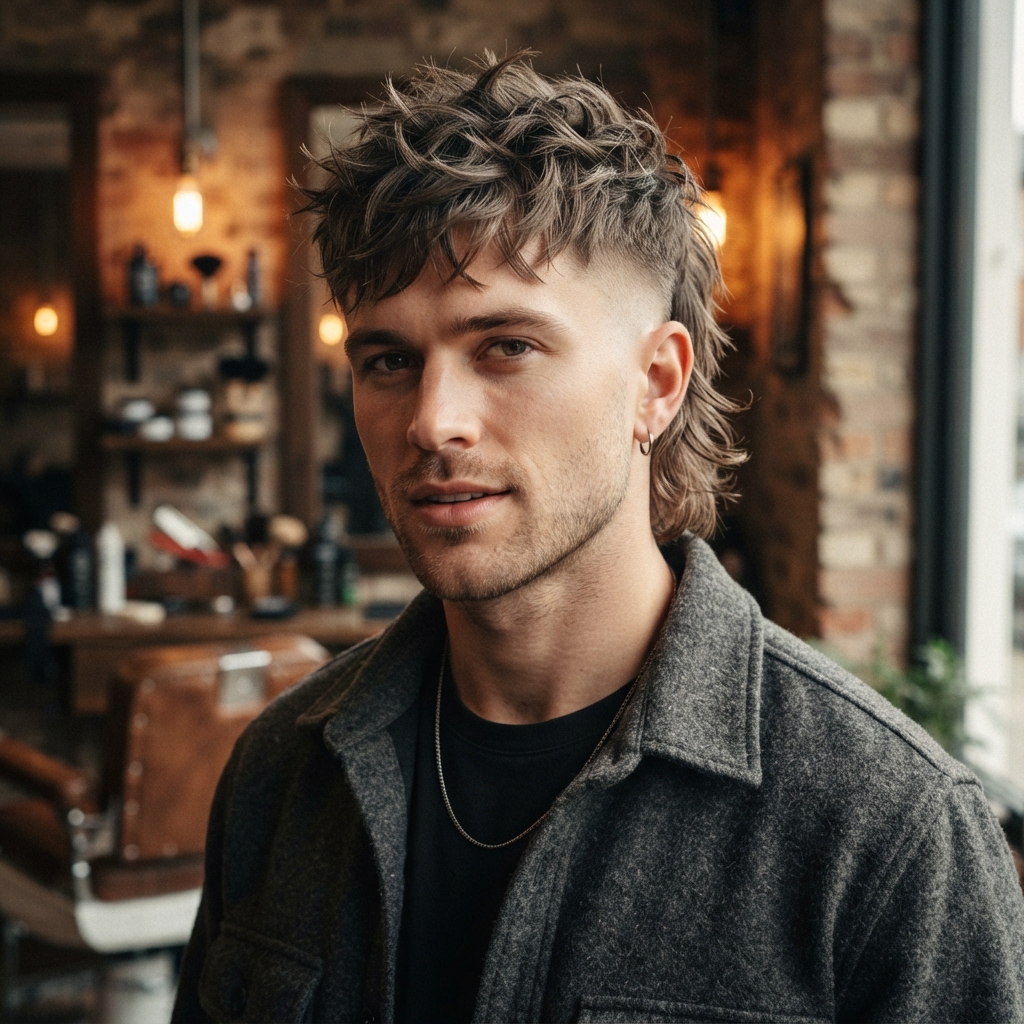
This version focuses heavily on movement.
The crown and back are layered and texturized so straight hair does not appear flat.
A matte product can then separate individual sections.
This is particularly useful if your hair is naturally straight and tends to sit in one direction.
8. Messy Straight Hair Mullet

A messy mullet deliberately avoids a polished finish.
The top is separated with fingers, while the back retains natural movement.
The haircut still needs structure underneath the messiness.
If the cut is poorly layered, simply adding texture product will not create a good shape.
9. Korean Mullet

A Korean-inspired mullet generally has a softer silhouette.
The front may include longer fringe or curtain-like sections, while the back is layered rather than dramatically disconnected.
This creates a more refined appearance than a traditional punk-inspired mullet.
It can be a good option for straight hair because the smooth texture naturally supports the layered shape.
10. Baby Mullet

A baby mullet is the subtle version.
The back is only slightly longer than the sides.
It allows you to test the hairstyle before committing to a stronger mullet.
It is also easier to wear in conservative environments.
Straight Hair Mullet Length Guide
The right length depends on the look you want.
Short back
Choose a short nape if you want a subtle mullet.
The difference between the sides and back remains visible without becoming dramatic.
Medium back
A medium-length nape creates the classic modern mullet silhouette.
It provides enough length for layers and movement while remaining relatively easy to manage.
Long back
A longer back creates a stronger statement.
It requires more maintenance because the ends become more noticeable as they grow.
Straight hair also makes the length difference highly visible, so the back needs to be shaped carefully.
The important point is that there is no universal “correct” mullet length. Your target style should determine the amount of length preserved.
Best Fade for Straight Hair Mullet
Choosing the fade changes the entire personality of the haircut.
| Fade or finish | Overall appearance | Maintenance |
| Scissor cut | Natural and soft | Lower |
| Low taper | Subtle and professional | Moderate |
| Low fade | Clean and modern | Moderate |
| Mid fade | Stronger contrast | Higher |
| High fade | Bold and dramatic | Higher |
| Burst fade | Distinctive and modern | Moderate to high |
| Skin fade | Maximum contrast | High |
If this is your first mullet, a low taper or low fade is usually an easier starting point.
You can always make the next haircut more dramatic.
How to Tell Your Barber You Want a Straight Hair Mullet
Simply saying “I want a mullet” leaves too much room for interpretation.
A better request is:
“I want a modern mullet for straight hair. Keep the top textured, keep the sides controlled, and leave noticeable but manageable length at the back. I want the transition layered rather than extremely disconnected.”
Then specify the sides.
For a conservative version:
“Give me a low taper around the temples and neckline. Keep the sides relatively full.”
For a stronger version:
“Give me a mid fade with a layered back and more contrast between the sides and nape.”
Also explain the final length you want.
For example:
“I want the back to reach the upper neck but not the shoulders.”
Your barber can then build the haircut around that target.
Should You Bring a Reference Photo?
Absolutely.
A photograph communicates the silhouette faster than a verbal description.
Ideally, show:
- Front view
- Side view
- Back view
Choose a reference model with hair similar to yours.
A thick straight-haired model can produce a very different result from someone with fine straight hair.
Also show your barber what you do not want.
For example, you can say that you want a modern mullet rather than an exaggerated retro tail.
How to Style a Straight Hair Mullet
Straight hair often needs help creating movement.
Fortunately, the styling routine does not have to be complicated.
Step 1: Start with damp hair
Wash your hair and gently towel-dry it.
Avoid aggressive rubbing because the longer back section can become prone to breakage when handled roughly.
Step 2: Apply heat protectant
If you are using a blow dryer or other heat styling tool, apply a suitable heat protectant first.
This is especially useful when the back is longer and exposed to repeated styling.
Step 3: Add texture
Use a lightweight styling product.
Good choices include:
- Matte paste
- Matte clay
- Texture spray
- Sea salt spray
- Lightweight styling cream
Straight hair generally does not need a heavy product.
Grooming guidance also recommends lighter products for straight hair because the goal is to add texture and movement without making the hair stiff.
Step 4: Blow-dry the crown
Use your fingers to lift the roots while directing airflow through the crown.
This creates volume.
You do not need to make the hair perfectly smooth.
Step 5: Shape the fringe
Push the fringe forward, sideways, or into a loose middle part.
Your choice depends on the haircut.
Step 6: Work the back
Use your fingers to separate the longer sections.
Allow the hair to move rather than pressing it flat against the neck.
Step 7: Finish with a small amount of product
Add a tiny amount of matte paste to the ends if additional separation is needed.
Do not overload the hair.
Best Products for Straight Hair Mullet
Matte paste
A good everyday option.
It provides flexible control while preserving a natural finish.
Matte clay
Useful for thicker straight hair that needs stronger grip.
It can also create a more defined textured appearance.
Texture spray
Useful when your hair is extremely straight and tends to fall flat.
It adds grip without making the hairstyle feel heavily styled.
Sea salt spray
It can create a rougher, more casual texture.
Use it moderately if your hair is dry because excessive use can make the hair feel rough.
Lightweight hairspray
Useful when you need extra hold for a specific occasion.
For everyday styling, it is usually unnecessary.
How Often Should You Maintain a Straight Hair Mullet?
Maintenance depends heavily on the sides.
If you have a fade or taper, the short sections will usually need attention before the longer back.
A practical schedule is around 3 to 5 weeks for fade or taper versions, while the longer back may need less frequent shaping. Some professional grooming guidance recommends around four to six weeks for general mullet maintenance, with earlier cleanups for faded versions.
You should consider a trim when:
- The fade becomes blurry
- The neckline loses its shape
- The crown becomes too heavy
- The back develops excessive bulk
- The ends begin looking uneven
The goal is to maintain the proportions rather than constantly shorten the back.
How to Keep the Longer Back Healthy
The back is often the longest part of a mullet, so it deserves attention.
Use conditioner regularly and avoid unnecessary heat.
If you use a blow dryer, use heat protection and avoid keeping extremely hot airflow on one section for too long.
Regularly check the ends for dryness and splitting.
Straight hair can make damaged ends especially visible because there is no curl pattern to disguise unevenness.
Why Does a Straight Hair Mullet Look Flat?
This is one of the most common problems.
Straight hair naturally falls downward.
If the crown has too much weight, it can collapse against the head.
The solution is usually a combination of:
- Strategic layering
- Root lift
- Texturizing
- Lightweight styling products
- Correct blow-drying technique
Do not simply ask your barber to remove as much hair as possible.
Over-thinning can create its own problems, particularly if your hair is fine.
The goal is controlled weight removal, not maximum thinning.
Why Does the Back of My Mullet Look Bulky?
Excessive weight can accumulate around the crown and nape.
This is especially noticeable with thick straight hair.
The barber may need to create additional layers or remove internal weight while keeping enough length at the ends.
The back should flow with the head rather than forming a heavy block.
If your mullet constantly sticks outward, the issue may be the cut rather than the styling product.
Common Straight Hair Mullet Mistakes
Cutting the back too short
If the nape is barely longer than the sides, the haircut may lose its mullet identity.
Leaving the back completely unlayered
Long straight hair without layering can hang heavily.
Making the fade too high
A high fade can create a disconnected appearance that may not match your desired style.
Over-thinning fine hair
This can make the hair appear even thinner.
Using too much pomade
Heavy products can flatten straight hair and make it look greasy.
Ignoring the neckline
The neckline has a major effect on the finished silhouette.
Discuss whether you want it natural, tapered, rounded, square, or slightly pointed.
Copying a celebrity haircut exactly
A reference image is useful, but your hair density, face shape, hairline, and growth pattern may differ.
Use the photograph as inspiration rather than expecting an identical result.
Straight Hair Mullet for Thin or Fine Hair
Fine straight hair can still support a mullet, but the haircut should be more conservative.
Avoid removing excessive density.
A shorter or subtle mullet can make fine hair look more controlled.
A textured fringe can also create visual interest without requiring extreme volume.
A softer taper may be preferable to a dramatic skin fade because excessive contrast can make thinner areas more obvious.
The goal is to create shape while preserving the hair you have.
Straight Hair Mullet for Thick Hair
Thick straight hair gives you many options.
You can experiment with:
- Long mullets
- Modern mullets
- Shaggy mullets
- Burst fades
- Textured mullets
- Layered backs
The main challenge is bulk.
Your barber may need to remove internal weight so the hair flows instead of forming a dense block.
Avoid excessively short layers if your thick hair naturally sticks outward.
Is a Straight Hair Mullet Professional?
It depends on the version.
A subtle low taper mullet with a moderate nape can look surprisingly polished.
A long, disconnected mullet with a high fade and dramatic texture is much more noticeable.
For professional environments, consider:
- Low taper
- Short or medium nape
- Soft layers
- Natural neckline
- Moderate fringe
For casual environments, you can experiment with longer back length, stronger fades, and more texture.
Straight Hair Mullet vs. Wolf Cut
The two styles overlap, but they are not identical.
A mullet places greater emphasis on the longer back.
A wolf cut distributes more layers throughout the crown and sides and generally has a shaggier silhouette.
Choose a mullet if you want a clear front-to-back contrast.
Choose a wolf cut if you want more all-around layering and a softer, shaggier appearance.
Straight Hair Mullet vs. Shag
A shag usually has more consistent layering throughout the head.
A mullet places more emphasis on the length at the back.
A shag can therefore appear more evenly distributed, while a mullet has a stronger directional shape.
Some modern hairstyles combine both concepts, creating a layered shaggy mullet.
Who Should Try a Straight Hair Mullet?
A straight hair mullet is worth considering if you:
- Want a distinctive hairstyle
- Like textured or layered hair
- Have straight or mostly straight hair
- Want to keep meaningful length at the back
- Are comfortable with a nontraditional haircut
- Want several styling options
- Do not mind regular trims
It may not be ideal if your workplace has strict grooming requirements or if you strongly prefer a uniform short haircut.
Your lifestyle matters just as much as your hair type.
Frequently Asked Questions:
Is a mullet good for straight hair?
Yes. Straight hair shows the layers and shape clearly, making it excellent for modern mullet styles.
What is the best mullet for straight hair?
A modern, low taper, textured, or Korean-inspired mullet is a versatile starting point for straight hair.
Does straight hair need layers for a mullet?
Usually, yes. Strategic layers can prevent the crown and back from becoming flat or excessively heavy.
How long should the back of a mullet be?
There is no fixed length. A short nape creates a subtle mullet, while more length creates a stronger silhouette.
Is a low taper good with a mullet?
Yes. A low taper creates a clean finish while preserving more fullness around the sides.
What fade looks best with a straight hair mullet?
Low fades, mid fades, and burst fades can all work. Your preferred level of contrast should determine the choice.
How often should a straight hair mullet be trimmed?
Most fade or taper versions benefit from maintenance around every 3 to 5 weeks, depending on growth and how sharp you want the sides.
What product is best for straight hair mullets?
Lightweight matte paste, clay, or texture spray can add grip and movement without excessively weighing the hair down.
Can a mullet work with thin straight hair?
Yes. A shorter, softer mullet can work well, but excessive thinning should generally be avoided.
Is a mullet the same as a wolf cut?
No. A mullet emphasizes length at the back, while a wolf cut relies more heavily on layered texture throughout the hairstyle.
Conclusion
A straight hair mullet men can wear successfully depends on one thing above all else: proportion.
Straight hair makes every detail visible, so the relationship between the top, sides, crown, and nape needs to be intentional. Too much length can make the back heavy, while too little can make the haircut lose its identity.
For your first mullet, a modern version with a low taper, textured crown, and moderate nape length is a reliable starting point. If you want something bolder, you can move toward a burst fade, longer back, or stronger disconnection.
Tell your barber exactly how much length you want to preserve and show reference photos from multiple angles.
With the right layering, lightweight styling products, and regular maintenance, straight hair can produce one of the cleanest and most defined versions of the modern mullet.

Zaria Rhodes is the lead editor and content curator at Lyrinexa, passionate about music, storytelling, and lyrical expression. With a deep love for discovering the meaning behind songs, she brings clarity, creativity, and accuracy to every post. Zaria is dedicated to providing readers with authentic lyrics, thoughtful interpretations, and a seamless music-exploration experience.

1 thought on “Straight Hair Mullet Men: Best Styles, Haircut Guide, Styling & Maintenance”